
Frequently used in lighting technique efficiency factor the term means luminous efficiency. In other words luminous efficiencyrefers to the performance of the lighting fixture. The lighting luminaire, which works with electricity, produces light in response to the power it consumes.
What is Luminous Efficiency Formula? What is the Unit?
The maximum luminous flux that the luminaire can produce (Lumen) to the maximum power consumed by the luminaire gives the efficiency factor of the light source. The unit of luminous efficiency is "lm/w".
- Luminous Efficiency (Efficiency Factor) = Luminous Flux (Lumen-lm) / Power (Watt-w)
For example, let's examine the measurement values for a 1 metre LED bar. The data or values in this example are purely for illustrative purposes. The bar LED, which consumes 6 watts of energy at 1 metre, provides 720 lumens of luminous flux, while when the LED power on it is changed, it provides 1080 lumens of luminous flux for 9 watts of power. Likewise, the lumen level is also increased by changing these values. As can be seen, except for the total LED power, the efficiency of the same bar LED model always remains at 120.
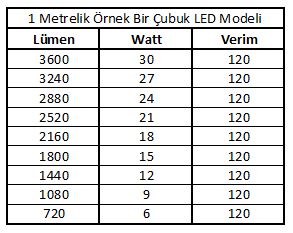
According to this example, users can choose a bar LED model with a luminous efficiency of 120, which gives a luminous flux according to their needs.
Efficient Lighting Amature
The other name of luminous efficiency is luminous efficacy. Luminous efficacy indicates the lighting power obtained by consuming a certain level of power. That is, the luminous flux (lumen) value given for 1 watt of power. When choosing a lighting fixture, it is desired to have low power consumption and high light production.
A luminaire that consumes more power but produces less luminous flux is inefficient. Because energy consumption is high according to the work done. Rod LED models provides maximum luminous flux with ideal power consumption. In addition, there are no electronic elements on the PCB (printed circuit board), only LEDs. SP120 model bar LED seriescontributes to the budget of users with high energy efficiency.
What are the Factors Affecting Luminous Efficiency (lm/w)?
Since the type of lamp used on the luminaire affects the electrical power consumed and the luminous flux, the efficiency also changes. Therefore, types such as fluorescent lamp, incandescent lamp, halogen lamp or high pressure sodium vapour lamp or LED directly affect the efficiency. In addition, additional parts such as lens, reflector or diffuser used in the luminaire will also affect the efficiency as they keep the light under control.
How is Luminous Efficiency Measured?
Measuring instruments, known as integrating spheres, measure the total light emitted from the luminaire in all directions, i.e. the luminous flux in lumens. After the maximum luminous flux is measured, the power calculation of the light source must be made. The maximum current is measured in Amperes from the cable from which the energy supply is made. Taking into account this Ampere value and the operating voltage, the maximum power (Watt) is found. Now a ratio can be made for Lumens per Watt. The value calculated with the Lumen/Watt formula is the luminous efficiency of the luminaire.
In addition, most luminaire manufacturers offer some specifications with the product. These specifications include maximum power consumption (watts) and luminous flux (lumens). Thanks to these values, the efficiency factor of the light source can be calculated through the lumen/watt formula.

 English
  Turkish
  German
  Arabic
  French
  Russian