
Choosing an LED driver is crucial for determining the heart of on/off facade lighting systems: the energy-managing component. Driver selection doesn't just ensure the light turns on; it also guarantees the system functions properly for years to come. Correct calculations will save you from unnecessary costs. Let's elaborate on this a bit.
What is an LED driver? And what is its role in On/Off systems?
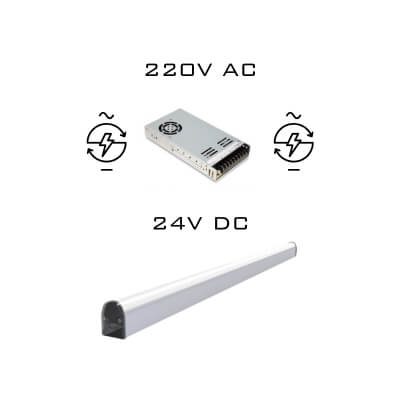
Other name power supply The LED driver device provides the energy required for the lighting system to operate. This is because the linear LED products we use in on/off facade lighting operate on 24V DC electricity. These devices convert 220V AC mains electricity into 24V DC energy.
Why should we use an LED driver instead of a standard adapter?
Standard adapters also maintain a stable voltage, but they are general-purpose devices. They cannot provide the precise control that LEDs require. A professional LED driver, however, acts as a barrier to a certain extent against sudden voltage fluctuations from the mains. This protects the LED chips and thus extends the life of the system. It also protects itself in case of short circuits. LED drivers minimize efficiency losses caused by internal circuit heating, even under harsh conditions. Furthermore, a high-quality LED driver maintains a balanced efficiency factor (luminous efficiency), prevents light flickering, and ensures stable light intensity. High-efficiency power supplies also offer energy savings.
Driver Compliance in On/Off Control Mechanism
The compatibility between the control mechanism and the driver is related to the system's activation speed. Therefore, the LED driver must have good switching stability. Professional drivers reliably handle the electrical energy from the control mechanism, minimizing the negative effects of sudden voltage spikes on the LED chips. For all these reasons, they ensure the facade lighting system operates smoothly for many years.
Technical Parameters: How to Determine the Right Driver?
First, you need to determine the voltage and driver type required for your LED products. To do this, you should check the voltage if the LEDs operate on a constant voltage, or whether they require a constant current. This section simply explains... What is Constant Current Power Supply? and What is Constant Voltage Power Supply? We will address these topics.
Constant Voltage (CV) and Constant Current (CC) Drives
- Constant voltage power supplies generally provide 24V or 12V DC electricity. This voltage is fixed. Constant current drivers, on the other hand, provide an output within a specific voltage limit, thus stabilizing the current. These products should be selected according to the type of LEDLine luminaire. Otherwise, the product may not work or may fail immediately.
- 24V DC constant voltage (CV) drivers are preferred in on/off facade systems. The main reason for this is that the luminaires used in these projects, especially linear LED products, have their own current-limiting resistors in their internal structure.
- Constant voltage drivers provide a stable 24V DC output to multiple LEDLine products connected in parallel. This allows for flexibility in system design. You can even add new fixtures, as long as you don't exceed the driver's capacity. This does not disrupt the driver's current balance.
Watt Kapasitesi Hesabı ve %20 Güvenlik Payı
Sürücüyü tam yükte çalıştırmamak önemlidir. Çünkü elektronik bileşenler kapasitelerinin sınırında çalıştıklarında aşırı ısı üretirler. Bu durum LED trafonun ömrünü dramatik bir şekilde kısaltır. Bu riski ortadan kaldırmak için toplam yükün üzerine en az %20 oranında bir güvenlik payı eklemelisiniz. Bu bir teknik zorunluluktur. Örneğin; 190W güç tüketen bir LEDLine grubu için tam 200W’lık bir sürücü bile yetersiz olur. Onun yerine 200W x 1,2 güvenlik payı = 228W olduğu için bir üst seviyesi olan 350W kapasiteli bir güç kaynağı tercih etmelisiniz. Bu yaklaşım, sürücünün daha serin çalışmasını sağlar ve verimliliği artırır. Böylece bu seçim What happens if the LEDs are getting too hot? As we mentioned in our guide, it minimizes the destructive effects of high temperatures on both the driver and the luminaire.
What type of power supply should I use?
Power supplies are divided into two categories: indoor and outdoor. Outdoor LED power supplies are more expensive. Therefore, you must first make the right choice. You should check if there is an area on the facade such as a cable shaft, installation room, panel room, or attic. If there is, you can use indoor power supplies. However, if there is no space for a panel inside, the power supplies must be on the facade to avoid voltage drop. In this case, you should choose an IP-protected LED driver suitable for outdoor conditions. This ensures that 220V AC current reaches the facade.
Efficiency and Lifespan Factors in Driver Selection
Brand is crucial when choosing LED drivers. High-quality brands can deliver the power they promise on their label, while low-quality products cannot. Therefore, using a low-quality product means you shouldn't rely on the stated power rating; you'll need to plan for a larger power supply. This increases costs and can lead to future malfunctions. For this reason, you should choose high-quality brands that operate with high efficiency and thus deliver maximum power. This will ensure durable facade lighting.
Critical Errors Made During Driver Assembly
- Installation in Confined Spaces Without Ventilation: 350W driver models generally have their own fan. Lower power models don't have this feature. However, you still need to be careful when mounting them in bulk on a panel. LED transformers should be placed in large panels, and preferably panels with fans. This way, they won't be affected by high temperatures, experience operational problems, or suffer from reduced efficiency.
- Incorrect AC Input Voltage and Fluctuations: You must correctly connect the AC cables at the driver input. For detailed information on this topic, see [link to relevant documentation]. How to Connect LED Transformer? You can read our article titled [article title]. Also, although LED drivers have their own protection mechanisms, you need to be careful in unstable networks like construction site electricity. You should use the drivers in a stable electrical network. Otherwise, you may find yourself needing additional investments such as AC regulators, UPS systems, and generators.
After selecting the right driver, let's turn to our main guide for robust facade lighting recommendations. Exterior On/Off Lighting: Professional Project Design Guide You can go to our article.
Don't risk the heart of your system with cheap but risky choices! Selecting the wrong LED driver can cause the lights on the facade to go out. It can also cause the entire system to overheat. This heat shortens the lifespan of your LED fixtures. To preserve the architectural value of your building and reduce maintenance costs to zero, let's determine the most suitable, high-efficiency driver combinations for your project together. Contact us today for a professional survey and the right driver supply.
