
LED lighting failures are quite frustrating. A facade light that burns like a rotten tooth is terrible. Has your exterior lighting system started malfunctioning just a few months after installation? Are some LEDs flickering, have others changed color, or is the light dimming? Unfortunately, technical errors in exterior projects quickly turn into major failures. Facade lights fail before even a year has passed. LED lighting failures are usually caused by choosing the wrong products that are not resistant to environmental factors. They can also stem from the drivers, which are the heart of the system. In this guide, you will discover the causes of your current failures. You will also learn tips for more durable facade lighting.
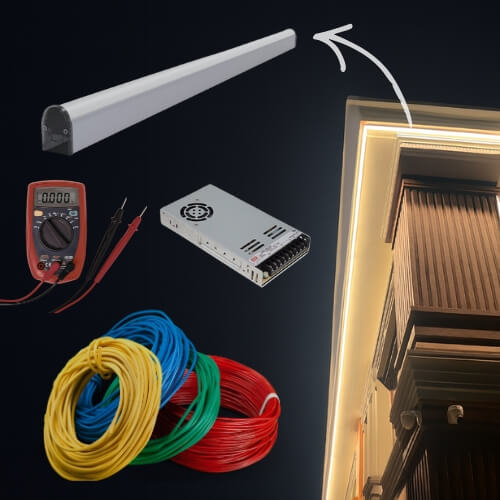
Most Common Facade Lighting Problems
Problems in exterior lighting projects generally stem from the weakest link. First and foremost, it's crucial to note that low-quality fixtures that can't withstand outdoor conditions lead to technical malfunctions. Furthermore, complex and incorrectly installed cabling or inadequate power supplies are also problematic. Unfortunately, these factors can quickly overshadow the building's overall visual splendor. By understanding the root of these problems, you can fix the existing fault and achieve much healthier lighting. But most importantly, this information allows you to make the right decisions from the outset, if a system doesn't already exist.
What causes LED flickering?
LED flickering is generally a problem caused by the LED driver. Here's some basic information on the subject. LED Driver Selection: Choosing the Right Driver for On/Off Facade Systems You can access this information from our article titled [article title]. Poor quality or worn-out capacitors inside the power supply are a problem. The driver's inability to handle the connected LED load also leads to voltage fluctuations. Furthermore, construction site electricity, irregular installations, or voltage irregularities from the grid can also trigger this situation. If you experience rhythmic flickering in your luminaires, this indicates that the system is overloaded or the driver quality is insufficient.
Light Intensity Decreases Over Time
The system losing its initial brightness is due to overheating and the use of low-quality LED chips. Are LEDs Resistant to High Temperature? As we detailed in our article, the luminaire housing needs to conduct heat. If an aluminum PCB and the correct housing are not used inside the luminaire, the generated heat cannot be dissipated. This high temperature causes the phosphor layer on the electronic components, especially the LED chips, to deteriorate. This means a loss of lumens. As a result, even if energy consumption remains the same, the light output will continue to decrease over time.
The lights at the end of the line are dimly lit.
If the lights at the beginning of your lighting line are bright and those towards the end are dimmer, there's a significant problem. This is a classic voltage drop issue. In low-voltage (24V DC) systems, the current encounters resistance as the cable distance increases. Therefore, the voltage drops at the end of the line. On/Off Facade Lighting Cabling Logic and Voltage Drop This problem occurs when the parallel power supply methods we mentioned in our article are not applied. LED luminaires do not receive the exact energy they need, leading to a visual light imbalance.
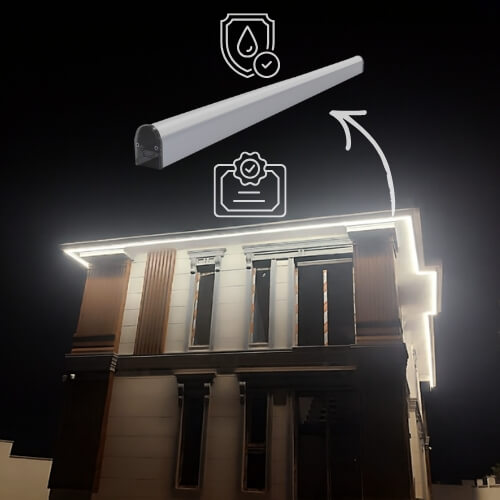
Behind the Scenes of the Problems: Where Did I Go Wrong?
System failures in exterior lighting projects are no accident. They all have a cause. Generally, technical details overlooked during the initial design phase are a contributing factor. Lower-quality choices, seemingly more economical and cheaper, will show their consequences shortly after the project is commissioned. Replacing the components with high-quality ones from scratch leads to high costs, not to mention crane or scaffolding expenses. Furthermore, it results in a loss of brand image. Understanding these chronic errors that underlie the failures is essential. Only then can you resolve the issue. durable facade lighting You can set up the system.
Incorrect IP Class Selection and Humidity Problems
Outdoor fixtures are constantly battling harsh conditions such as dust, rain, snow, and high humidity. You shouldn't rely solely on products with protective gaskets. These types of products can leak moisture over time due to expansion caused by temperature differences. Furthermore, old and hardened gaskets can become ineffective. If the products absorb moisture, oxidation and short circuits can occur, ultimately leading to fixture failure.
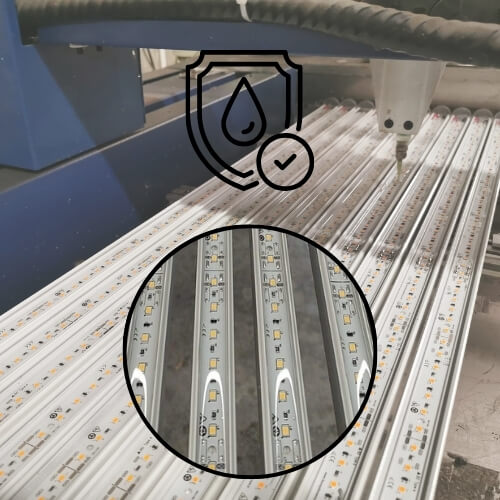
Transparent silicone-based polymer-filled products used in professional solutions have a much longer lifespan. This is because the silicone, which completely surrounds the inside of the aluminum casing, physically makes it impossible for water to reach the electronic components. What is IP Protection in Lighting? As we emphasize in our guide, moisture protection should be achieved not just with a lid, but with sealing technology in the internal structure.
Insufficient Power Supply (Driver) Capacity
One of the biggest mistakes made in many projects power supply tam kapasiteyle çalıştırmaktır. Hatta çoğu zaman sınır değerlerde çalıştırmanız bile bir problemdir. Bir LED sürücüyü toplam yükünün %100’ünü taşıyacak şekilde seçmemelisiniz. Çünkü dış ortam sıcaklıkları ile birlikte led driver yüksek seviyede ısınır. Böylece driver termal koruma moduna geçer, kapanır veya tamamen bozulur.
Uzun ömürlü bir cephe aydınlatma sistemi için sürücü kapasitesinde mutlaka en az %20 güvenlik payı bırakmalısınız. Bu pay ani voltaj dalgalanmalarını sönümler. Ayrıca sürücünün daha düşük ısıda ve stabil bir performansla çalışmasını sağlar. Ayrıca piyasada bilinen kaliteli markaları tercih etmelisiniz. Çünkü ucuz ve kalitesiz ürünler etiketinde yazan Watt gücünü zaten sağlayamaz. Bu güvenlik payı onlar için yetersiz bile kalır. Sonuç olarak LED aydınlatmada arıza riskini minimize etmek için kaliteli led sürücü ve %20 güvenlik payını unutmamalısınız.
Case Designs That Cannot Dissipate Heat
LEDs produce light but also generate heat. This heat needs to be quickly dissipated from the chips. Plastic housings or housings with insufficient wall thickness cannot conduct the heat received from the LEDs. In fact, they can even act as insulators, trapping heat inside. If heat dissipation is not done quickly, the internal structure of the chips is damaged, color shifts begin, and ultimately, they fail and burn out. This is where the vital role of an aluminum housing comes into play. Because aluminum PCBs and aluminum housings have high thermal conductivity, heat is transferred from the chips to the PCB board and then to the housing, finally being naturally released into the atmosphere. Choosing an aluminum PCB and aluminum housing combination in your projects is the most strategic investment you can make to extend the lifespan of your facade lighting system.
Troubleshooting and Repair Guide
When a malfunction occurs, you need to determine whether the source of the problem is the LED fixture, the wiring, or the power supply. The following steps will help you analyze technical malfunctions in exterior lighting systems with a professional eye.
How do I check the voltage with a multimeter?
The first step in troubleshooting is measuring the voltage. Set the multimeter to the DC voltage range (usually around 200V) and measure the power supply points of the system.
- First, measure the voltage at the output of the LED transformer. If the LED fixtures are 24V DC and your transformer has a 24V output, you should see exactly 24V in this measurement.
- If the voltage at the transformer output is normal, you should check the input of the luminaire at the end of the line. That is, you should go to the final supply point and repeat the measurement. If the value at the final point drops to 20V or below, there is a voltage drop problem.
- To avoid voltage drop, you need to increase the cable cross-section. You should also check for loose connections at the connection points.
- If there is a constantly fluctuating and unstable voltage value, the driver may have reached the end of its lifespan. Or there may be problems with the 220V AC mains supply.
How can I insulate a faulty light fixture?
If you have done the wiring correctly, a short circuit in a single luminaire in a complex exterior wall system will not affect the others. However, if you have done the wiring incorrectly, this problem will cause the entire line to burn out or the driver to go into protection mode. To find the faulty area, you should try the split-half method. First, disconnect the connection at the midpoint of the line and reconnect the power. If the first half of the line lights up, you can say that the fault is in the second half. If it doesn't light up, the problem is somewhere in the first half or in the main power supply. Once you have identified the faulty luminaire, you should disconnect that unit and bypass it. You should do this by insulating the cable ends with heat shrink tubing.
Professional Solutions to Avoid Further Problems
- Don't prioritize facade lighting due to economic concerns. Never compromise on quality products. The cost of making a mistake will be much higher in the long run.
- If your budget is insufficient, reduce the quantity. If it still doesn't fit your budget, postpone the project. Whatever the case, don't use low-quality, cheap products for facade lighting.
- Avoid using silicone-coated LED strips, neon LEDs, or tube LEDs. If you absolutely must use them, try to obtain high-quality, guaranteed products.
- Choose models with an aluminum casing and an aluminum PCB.
- The inside of the linear LED housing should be filled with transparent silicone (polymer).
- Use a good quality power supply.
- Güç kaynağında en az %20 güvenlik payı bırakın.
- Use the correct cross-section for cabling. Trying to cut costs by using thinner cables will come back to haunt you.
- In addition to series wiring, also use parallel power supplies. This will prevent voltage drop. Furthermore, a faulty luminaire will not affect the others.
If your current system is constantly malfunctioning, don't worry. It's time to solve this problem once and for all. By analyzing your current malfunctions, we offer the most durable and long-lasting system for your building. Contact us to get the right product and professional engineering support, and let us illuminate your facade forever. We also offer a general range of products. LED catalogue You can also check out our page.
