
Although exterior lighting panel placement and switchgear selection are technical matters, you need to know the general principles. We will focus particularly on how to design a safe exterior lighting panel, where to place it, the importance of temperature management, switchgear quality, terminal block arrangement, and labeling. Because the electrical infrastructure is just as important as the LED luminaire itself. Proper project planning is necessary for safe use. Now let's look at some details.
How should a professional on/off facade lighting panel be placed and designed?
First, we would like to state that we do not recommend the use of 220V AC electricity on the battlefield. Especially in outdoor environments, where factors such as snow and rain, and the possibility of human contact are present, you should prefer a lower voltage. 12V DC systems are safe, but significant voltage drops occur over long cable distances. Therefore, the ideal voltage is systems operating at 24V DC. Having clarified this point, we can now detail the panel location and heating issue.
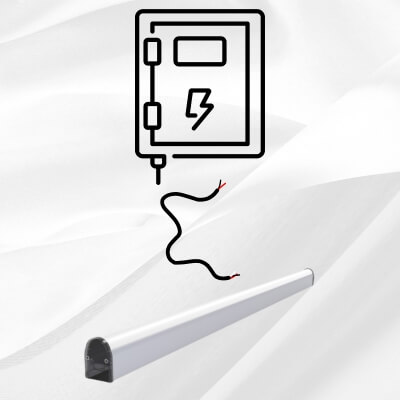
Where should the notice board be located?
Your initial focus should be on keeping the distance between the panel and the first LED fixture as short as possible. The panel contains power supplies that convert 220V AC electricity to DC energy. So, 220V enters the panel and 24V exits. If the distance between the facade and the main distribution panel is too great, this distance needs to be bridged at the high-voltage section. This is because DC electricity experiences greater voltage drop over long distances.
Voltage drop means progressively dimming the light. To prevent this, you need to use thicker cables, which means higher costs. To ensure both proper system operation and reduced costs, electrical supply panels should be located very close to the building facade. This is the most practical method. Therefore, you should plan for locations such as cable shafts close to the building facade or edges near the facade on the roof.
Panel Interior Heat Management and Ventilation
Electrical devices operate at a certain efficiency level. For example, in a motor, some energy is converted into rotational force and some into heat. In lighting, some energy is converted into light and some into heat. The less unnecessary heat produced, the more efficiently the device operates. To achieve maximum efficiency, you need to use high-quality devices, but even then, some heat will still be generated. So, what about devices and...? What happens if the LEDs are getting too hot?
The main enemy of these devices is the high temperature caused by this heat. Because the lifespan of electronic components is shortened by exposure to high heat. To increase durability and ensure long-term use, the ambient temperature must be quickly dissipated from the device. For example, low-wattage power supplies don't require fans, while high-wattage LED transformers use cooling fans. This is for heat control.
Electrical panels also contain heat sources such as circuit breakers, fuses, residual current devices, time control relays, contactors, and power supplies. Therefore, the inside of the panel must not overheat. For successful heat management inside the panel, it should be as spacious as possible. Otherwise, components cramped in a small space will heat up the inside of the panel quickly. Additionally, having a thermostatically controlled fan in the panel simplifies things. This way, when the temperature inside the panel reaches a certain level, the fan activates and transfers the hot air outwards.
Switchgear Selection
Selection of switchgear within the panel. On Off lighting This is one of the important parameters required for the healthy functioning of the system. You must design the appropriate control panel and... lighting project You should include it. Of course, the lighting project as well. lighting design It must be compliant with the scope.
Selection of Fuse (W-Automatic), Relay or Contactor.
You may want to control your facade lighting system manually or automatically. For automatic control, you can use components such as photocell relays, astronomical timers, time relays, and contactors. Whichever system you choose, you must use protection and control elements such as circuit breakers, residual current devices, or fuses at the panel's power input. These are essential for the safety of the system. In short, all these elements are switchgear. When choosing switchgear, you should opt for well-known, high-quality brands in the market.
Terminal Layout and Cable Labeling
Terminal blocks ensure secure and organized cable connections. They are also useful for grouping, as lighting circuits, control circuits, and power lines should be grouped in separate terminal blocks. Furthermore, organized terminal block placement speeds up the detection of potential system malfunctions. Remember that you must make tight and correct terminal connections to prevent loose connections. This will help prevent arc formation and fire hazards.
Cable labeling is also very important. Each cable should be labeled to indicate which circuit or luminaire group it belongs to. These labels should be clear, indelible, and easy to read. Labeling ensures that the system looks both safe and professional. Even if you have no other option, you should at least write the relevant power supply point in a few places on the cables with an indelible pen.
| Subject | Critical Mission | Points to Note |
|---|---|---|
| Panel | Power supply | You should place the sign as close to the facade as possible. |
| Panel Internal Fan | Heat dissipation | You should place it in the hottest spot on the panel, which is the top. |
| Switchgear | Energy control | It should be the appropriate type for the capacity and you should choose quality brands. |
| Terminals | Cable bundling | You must make the connections properly and securely. |
If you've already covered the issues of correct panel layout, switchgear selection, terminal block and cable arrangement, then you can turn to our main guide for the wiring logic. Exterior On/Off Lighting: Professional Project Design Guide You can return to our article.
The biggest risk in exterior lighting is a poorly designed power supply system. Switchgear that does not meet standards and cramped panel placement shorten the system's lifespan and increase the risk of fire. Don't leave the safety of your building to chance. Contact us immediately for recommendations.
